
From Conflict to Resolution: Your Guide to Commercial Property Legal Disputes
Why Commercial Property Legal Disputes Require Swift Action

Commercial property legal disputes can derail business operations, drain resources, and damage valuable relationships. Whether you're a landlord dealing with non-paying tenants or a business owner facing unexpected service charge increases, these conflicts demand immediate attention and strategic resolution.
The most common commercial property legal disputes include:
• Lease disputes - rent arrears, service charge disagreements, maintenance responsibilities
• Boundary and easement conflicts - property lines, access rights, encroachments
• Purchase/sale issues - title defects, misrepresentation, financing problems
• Zoning and land use disputes - regulatory compliance, permit violations
• Construction and development conflicts - contract breaches, cost overruns
According to industry data, lease disputes account for approximately 60% of all commercial property legal disputes, with non-payment of rent being the leading cause. The financial stakes are significant - commercial property disputes can take 3 to 18 months to resolve, with litigation costs often exceeding $50,000 in complex cases.
The good news? Over 80% of commercial property disputes are resolved through negotiation, mediation, or arbitration rather than costly court battles. Early intervention and clear communication often prevent minor disagreements from escalating into major legal conflicts.
As one industry observer noted: "Commercial property disputes are an inevitable part of owning, leasing, or managing property." The key is knowing how to handle them efficiently when they arise.
Mapping the Landscape of Commercial Property Legal Disputes
Think of commercial property legal disputes as a complex map with different territories, each presenting its own challenges and risks. Whether you're navigating a simple rent collection issue or finding yourself in the middle of a multi-million-dollar construction conflict, understanding this landscape helps you chart the best course forward.
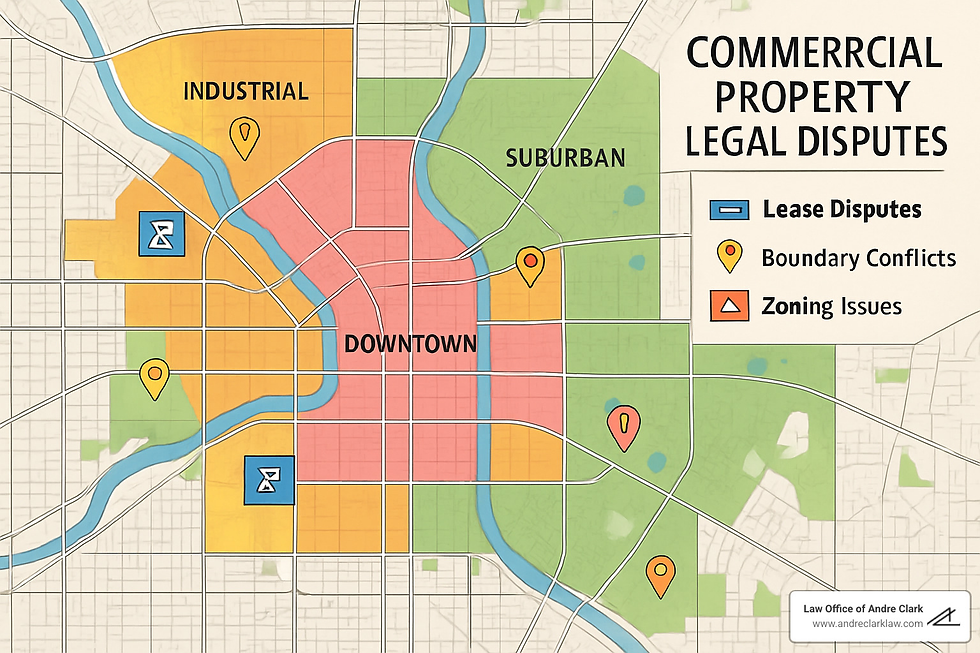
The terrain of commercial property conflicts spans five main regions: lease disputes that account for the majority of cases, boundary and easement conflicts that can freeze entire developments, purchase and sale issues that derail transactions, zoning and land use disputes that challenge regulatory compliance, and construction conflicts that often involve multiple parties and substantial financial exposure.
Most Common Commercial Property Legal Disputes
When we look at the data, clear patterns emerge in how these conflicts unfold. Rent arrears sit at the top of the list, creating immediate cash flow problems for landlords while putting tenants' business survival at risk. These disputes often escalate quickly because money isn't coming in, bills still need paying, and emotions run high on both sides.
Service charge spikes represent another major flashpoint. Picture this: you're a retail tenant who budgeted $2,000 monthly for building charges, then suddenly receive a bill for $4,500 with little explanation. These unexpected increases trigger demands for detailed cost breakdowns and heated challenges to calculation methods.
Maintenance failures create disputes when a problem occurs and nobody's quite sure who should fix it. That leaking roof might seem obviously the landlord's responsibility, but if your lease says you handle all repairs, suddenly you're looking at structural work costs plus interior damage. The finger-pointing can get intense.
Quiet title actions emerge when property ownership becomes murky. Maybe there's a competing claim from an undisclosed heir, or a previous transfer had defects that weren't caught. These disputes can completely freeze property transactions and create uncertainty that affects everyone involved.
Partition actions happen when co-owners of commercial property can't agree on management, use, or sale decisions. California law allows any co-owner to force a partition at any time, potentially compelling a sale even when other owners strongly object.
How Lease Terms & Ambiguities Spark Commercial Property Legal Disputes
Here's where things get interesting: many commercial property legal disputes could be avoided entirely with clearer lease language. Poorly drafted agreements are like ticking time bombs, waiting for the right circumstances to explode into conflict.
Unclear repair clauses cause ongoing headaches. A lease might say the tenant handles "repairs," but what happens when the HVAC system needs complete replacement? Is that repair, replacement, or improvement? Without specific definitions, every maintenance issue becomes a potential battleground.
Break options frequently generate conflicts when triggering conditions are vague. A tenant might believe they've jumped through all the required hoops to terminate early, while the landlord argues certain technical requirements weren't properly satisfied. The stakes are high—missing a technical requirement can cost tenants their right to escape an unwanted lease.
Rent review formulas often work fine in theory but create problems in practice. Market rent assessments sound straightforward until you're trying to find comparable properties in a unique location. Indexation formulas seem mathematical and objective until unexpected economic conditions make the results seem unfair to one party.
Subletting permissions create another common conflict zone. Leases typically require landlord consent for assignments or subleases but often fail to specify approval criteria or decision timeframes. This ambiguity leads to disputes when landlords refuse reasonable requests or delay decisions indefinitely, sometimes as a negotiating tactic.
For property owners looking to avoid these common pitfalls, working with experienced legal counsel on contract drafting can prevent many disputes before they start. Clear, comprehensive lease terms might cost more upfront, but they save significant time, money, and stress down the road.
Causes, Consequences, and Prevention
Understanding why commercial property legal disputes arise—and their potential impact—enables property stakeholders to take preventive action. The research shows that proactive measures significantly reduce both the likelihood and severity of conflicts.

Primary Causes Between Landlords and Tenants
The landlord-tenant relationship generates most commercial property conflicts, with patterns that repeat across different markets and property types. Recognizing these warning signs early can prevent minor issues from becoming major legal battles.
Late rent payments often signal deeper financial troubles brewing beneath the surface. While an occasional delay might be understandable, persistent lateness typically indicates cash flow problems that could spiral into default. Savvy landlords monitor payment patterns closely and reach out to discuss concerns before formal defaults occur.
When triple-net shortfalls emerge, tensions can escalate quickly. Under these lease arrangements, tenants pay their share of property taxes, insurance, and maintenance costs on top of base rent. Problems arise when costs spike unexpectedly—perhaps from a major roof repair or property tax reassessment—and tenants push back, questioning whether charges are reasonable or properly calculated.
Unauthorized alterations create another common friction point. Tenants often make improvements to suit their business needs without seeking landlord approval first. The real conflict usually surfaces at lease termination when disagreements arise about whether improvements must be removed or can stay. What seemed like a simple upgrade becomes a costly restoration battle.
Nuisance operations can trigger disputes between landlords and tenants or spark conflicts between neighboring businesses. Excessive noise, strong odors, heavy traffic, or activities that interfere with other tenants often lead to complaints and potential lease violations. These situations require careful handling to maintain relationships while addressing legitimate concerns.
For more insights on navigating these challenges, see Why Is It Important to Negotiate Commercial Leases?
Typical Consequences for Stakeholders
Unresolved commercial property legal disputes create ripple effects that extend far beyond the immediate parties involved. The financial and operational damage can be significant and long-lasting.
Cash-flow loss hits landlords immediately when rent disputes develop. A single non-paying tenant in a small commercial building can create serious financial strain, particularly when landlords have mortgage payments and other fixed expenses to cover. For tenants, disputes disrupt business operations and pull management attention away from core activities that generate revenue.
Property depreciation becomes a real concern when disputes prevent proper maintenance or improvements. Buildings caught in ongoing conflicts between owners and tenants often suffer from deferred maintenance, reducing market value and making the property less attractive to future tenants or buyers. This creates a downward spiral that hurts everyone involved.
Transaction collapse represents one of the most expensive consequences. When purchase or sale disputes arise, entire deals can fall apart after months of effort and significant transaction costs. Buyers may forfeit deposits while sellers face continued carrying costs and renewed market uncertainty. The Landlord and Tenant Act 1954 Termination guide provides important context for understanding lease termination rights that can affect property transactions.
Reputational harm affects all parties in commercial property disputes. Landlords known for contentious relationships struggle to attract quality tenants, while tenants with dispute histories may find it harder to secure desirable space in competitive markets. In commercial real estate, reputation matters significantly for long-term success.
Proactive Prevention and Due Diligence
Prevention remains the most cost-effective approach to managing commercial property legal disputes. Upfront investment in proper documentation and due diligence consistently pays dividends by avoiding costly conflicts down the road.
Pre-lease surveys establish clear baseline property conditions before tenants take possession. Professional inspections document existing issues and prevent disputes about responsibility for pre-existing problems. This straightforward step eliminates many end-of-lease dilapidation disputes that can cost thousands to resolve.
Environmental assessments are particularly crucial for commercial properties, especially older buildings or those with industrial history. Phase I and Phase II environmental studies can uncover contamination issues that might otherwise surface during ownership transfers or redevelopment projects, creating expensive surprises for unprepared parties.
Clear repair schedules eliminate ambiguity about maintenance responsibilities that often trigger disputes. Rather than using general language about "repairs," successful leases specify exactly what each party must maintain, including HVAC systems, roofing, plumbing, electrical systems, and structural elements. This precision prevents most maintenance-related conflicts.
Title insurance provides protection against hidden defects in property ownership. While not foolproof, title insurance offers financial protection and professional investigation of ownership history that can prevent costly title disputes from derailing transactions or ongoing operations.
For additional guidance on protecting contractual interests and enforcement options, review Ways to Enforce Real Estate Contracts.
Resolution Pathways: From Dialogue to Courtroom
When commercial property legal disputes arise, the path to resolution doesn't have to lead straight to a courtroom. Smart property owners and tenants today have multiple options for resolving conflicts, each offering different advantages depending on the situation at hand.

The reality is that over 70% of commercial property disputes now get resolved through alternative methods rather than traditional litigation. This shift makes sense when you consider that most property conflicts stem from misunderstandings or changing business circumstances rather than fundamental legal violations.
Think of dispute resolution as a ladder. You start with simple conversation at the bottom and climb toward more formal procedures only when necessary. Each rung up the ladder involves more time, cost, and formality—but also provides stronger enforcement mechanisms.
Alternative Dispute Resolution Methods
Interest-based negotiation sits at the foundation of effective dispute resolution. Instead of arguing about who's technically right according to the lease, smart parties focus on what each side actually needs to succeed.
Consider a tenant facing unexpected rent increases due to rising property taxes. Rather than fighting over lease interpretation, a creative landlord might offer a graduated payment schedule or accept a percentage of future business growth. These solutions often work better than rigid contract enforcement because they address underlying business realities.
Mediator selection can make or break the mediation process. The most effective mediators bring both real estate knowledge and strong people skills to the table. They understand property law nuances while helping parties see past their immediate frustrations to find workable solutions.
Good mediators don't impose decisions—they facilitate conversations that parties couldn't have on their own. They might suggest creative payment arrangements, modified lease terms, or phased implementation of disputed obligations that satisfy everyone's core needs.
Arbitration clauses work particularly well for specific types of commercial property legal disputes. Rent review calculations, service charge assessments, and property valuation disagreements often benefit from arbitration because they involve technical determinations rather than broad relationship issues.
The beauty of arbitration lies in its predictability. Parties know upfront how disputes will be handled, who will decide them, and roughly how long the process will take. This certainty helps prevent conflicts from escalating while providing a clear path forward when disagreements arise.
For businesses dealing with complex property-related conflicts, Business Litigation services can provide guidance on the most appropriate resolution approach.
When Litigation Becomes Necessary
Despite the advantages of alternative resolution methods, some situations demand court intervention. Recognizing these scenarios helps parties avoid wasting time on inappropriate resolution attempts.
Breach severity often determines whether litigation makes sense. A tenant who's a few days late on rent might resolve things with a phone call, but unauthorized property transfers or major structural violations typically require formal legal action to protect everyone's interests.
Injunctive relief needs frequently drive litigation decisions. When someone's actions threaten immediate harm—like construction that blocks access or activities that violate zoning requirements—only courts can provide the emergency intervention necessary to prevent further damage.
Some disputes involve complex evidence gathering that requires court supervision. Fraud allegations, hidden financial arrangements, or disputes over extensive property records often need formal findy procedures to uncover the truth.
Court costs exceeding $50,000 make litigation a serious financial commitment, but sometimes the stakes justify this investment. When property values or ongoing business viability hang in the balance, formal legal proceedings may be the only way to achieve definitive resolution.
Jurisdictional rules also influence timing decisions. Certain property disputes—particularly those involving ownership questions or partition actions—must be resolved through specific court procedures that establish legally binding determinations.
For guidance on understanding commercial property regulations, the RICS service charge statement provides valuable technical background.
Steps for Efficient Resolution
Regardless of which resolution path you choose, certain steps dramatically improve your chances of success in commercial property legal disputes.
Early case assessment helps everyone understand what they're really dealing with. This means looking beyond immediate frustrations to evaluate legal positions, business objectives, and realistic outcomes under different scenarios. Sometimes what feels like a major dispute has a simple solution once everyone understands the full picture.
Evidence preservation becomes crucial the moment disputes emerge. Smart parties immediately secure relevant documents, communications, and physical evidence before anything gets lost or destroyed. Digital communications, financial records, and property condition photos often prove decisive in resolution discussions.
Settlement framework development provides structure for productive negotiations. Rather than endless back-and-forth discussions, successful resolutions often result from organized proposals that address all key issues and implementation details upfront.
Enforcement planning ensures that agreements actually work in practice. The best settlements include specific performance milestones, regular check-ins, and clear procedures for handling future compliance issues.
Resolution agreements are only as good as their implementation. Smart parties plan for success by building monitoring and adjustment mechanisms into their settlement terms.
For comprehensive guidance on making agreements stick, see Ways to Enforce a Contract and How an Attorney Can Help You.
Special Focus Areas: Repairs, Zoning, and Purchase/Sale Pitfalls
Certain categories of commercial property legal disputes require focused attention due to their complexity and potential for significant financial impact. Understanding these areas helps property stakeholders recognize and address problems before they escalate into costly legal battles.

Repair, Maintenance, and Dilapidations in Commercial Leases
Dilapidations and repair obligations show up in about 20% of commercial landlord-tenant disputes, making this one of the most heated areas in commercial leasing. The problem? What seems straightforward on paper often becomes murky in real-world situations.
Full-repairing obligations sound clear until you dig into the details. When a lease says the tenant must "repair" everything, does that include replacing a 20-year-old HVAC system that finally gives up? What about upgrading electrical systems to meet new safety codes? The word "repair" can mean vastly different things to landlords and tenants, especially when big-ticket items are involved.
Schedule of condition documents serve as your insurance policy against future headaches. Think of it as taking photos of a rental car before driving off the lot. Professional surveys with detailed photographs and descriptions create an objective record of what the property looked like when the tenant moved in. Without this baseline, you're left arguing about whether that crack in the wall was there from day one or happened during the lease term.
Exit reinstatement requirements often blindside tenants who assumed they were doing the landlord a favor by leaving improvements behind. Many commercial leases actually require tenants to strip out everything they added and restore the space to its original condition. That beautiful custom kitchen or expensive flooring upgrade? It might all have to go, potentially costing tens of thousands of dollars that tenants never budgeted for.
Cost recovery mechanisms need crystal-clear definition to prevent disputes. Tenants have every right to understand how repair expenses are calculated and whether they're getting charged fairly. Smart lease agreements specify exactly how costs are documented, allocated, and verified to avoid the inevitable "why am I paying for this?" conversations.
The research shows that dilapidation disputes often involve substantial sums and can significantly delay lease terminations or property transfers. Regular property inspections and clear documentation help minimize these conflicts before they spiral into legal battles.
Zoning, Planning, and Regulatory Compliance Disputes
Zoning might seem like dry municipal law, but it creates some of the most frustrating commercial property legal disputes because the rules keep changing and the stakes can be enormous.
Use-class changes trip up business owners who want to evolve their operations but run into invisible regulatory walls. Picture a successful restaurant owner who wants to add live music to attract more customers. Sounds reasonable, right? But if the property is zoned for restaurants only, or if noise ordinances prohibit entertainment venues, that simple business decision becomes a legal nightmare involving permits, variances, and potentially unhappy neighbors.
Conditional permits create ticking time bombs in commercial properties. A shopping center might have approval based on maintaining specific parking ratios or traffic patterns. When a popular new tenant draws more customers than expected, suddenly the property is violating its permit conditions. The result? Forced operational changes, potential fines, or even permit revocation that could shut down businesses.
ADA access requirements continue evolving in ways that surprise property owners. When accessibility improvements become necessary, the question of who pays can spark major disputes. Is upgrading restroom facilities a tenant improvement or a landlord obligation? The answer often depends on lease language that seemed unimportant until the compliance notice arrived.
Local planning appeals become necessary when zoning decisions threaten valuable property rights. These proceedings can drag on for months and cost thousands in legal fees, but sometimes they're the only way to protect a property's intended use or development potential.
Understanding your local zoning landscape and staying current with regulatory changes helps prevent these disputes from blindsiding your business plans.
Legal Issues in Purchasing or Selling Commercial Property
Purchase and sale transactions generate their own unique category of commercial property legal disputes, often involving substantial sums and time-sensitive deadlines that make every problem feel like a crisis.
Warranties and representations in purchase agreements create lasting liability that extends well beyond closing day. When sellers make statements about property income, condition, or legal status, buyers rely on those assurances to make decisions and set prices. If those statements turn out to be wrong—whether intentionally or accidentally—the resulting disputes can involve damage claims that dwarf the original purchase price.
Escrow controversies arise when deal conditions aren't clearly met or when parties disagree about whether requirements have been satisfied. Title problems finded during final review, financing that falls through at the last minute, or inspection findings that weren't anticipated can all trigger escrow disputes. These situations often leave both parties frustrated and potentially facing significant financial losses.
Hidden liens represent every buyer's nightmare scenario. Mechanics' liens from unpaid contractors, tax liens from previous owners, or judgment liens that somehow escaped initial title searches can surface just days before closing. Suddenly, a smooth transaction becomes a scramble to resolve debt obligations that may have been accumulating for years.
Finance failures can devastate carefully planned transactions when buyers can't secure promised financing or when loan terms change dramatically from initial commitments. These situations frequently lead to disputes about deposit forfeiture, damage recovery, and who bears responsibility for deal collapse.
Industry data indicates that title defects or unexpected encumbrances delay or completely derail up to 25% of commercial property sales transactions. Comprehensive due diligence and title insurance provide crucial protection, but they can't prevent every surprise that emerges during complex commercial deals.
For assistance with real estate transaction disputes, consider Real Estate Litigation services that can help steer these challenging situations.
Drafting Strong Commercial Property Agreements
Prevention remains the best strategy for avoiding commercial property legal disputes. Well-drafted agreements that anticipate common problems and provide clear resolution mechanisms significantly reduce conflict likelihood and severity.
Think of a commercial lease as the roadmap for a business relationship that might last decades. When that roadmap has missing streets or unclear directions, people get lost—and frustrated. The most successful commercial property agreements anticipate where problems typically arise and provide clear guidance for handling them.
Clear covenants form the foundation of dispute prevention. Rather than vague language about "maintaining the premises in good condition," effective leases spell out exactly what this means. Who handles HVAC filter changes? What happens when the roof needs replacement? How quickly must broken windows be repaired? These details might seem tedious during negotiations, but they prevent countless headaches later.
The difference between "tenant shall maintain the property" and "tenant shall perform monthly HVAC filter changes, quarterly gutter cleaning, and annual carpet professional cleaning" is the difference between clarity and confusion. Specific obligations leave little room for interpretation disputes.
Dispute-resolution clauses act like insurance policies—you hope you'll never need them, but you'll be grateful they exist if conflicts arise. These provisions should establish a clear escalation path, typically starting with direct negotiation, moving to mediation, and potentially ending in arbitration or litigation. Include realistic timelines that give parties adequate opportunity to resolve issues without allowing disputes to drag on indefinitely.
Smart agreements also specify who pays for dispute resolution costs and whether the prevailing party can recover attorney fees. These provisions often encourage reasonable settlement discussions rather than prolonged conflicts.
Rent review mechanics deserve particular attention because rent disputes generate more commercial property legal disputes than almost any other issue. Successful rent review clauses specify the exact calculation method, timing requirements, and fallback procedures if parties can't agree on market rates.
Consider including specific comparable properties for market rent determinations or predetermined formulas for index-based increases. The goal is eliminating subjective judgments that create disagreement opportunities.
Force majeure provisions have gained critical importance following recent economic disruptions. Modern agreements should clearly define what events excuse performance—pandemics, natural disasters, government shutdowns—and establish specific notice requirements and mitigation obligations.
These clauses shouldn't be afterthoughts copied from old contracts. They need to reflect current realities and provide practical guidance for handling extraordinary circumstances that affect property operations.
Insurance requirements create another frequent source of disputes when coverage gaps emerge during actual loss events. Effective agreements specify not just coverage amounts but also additional insured status, deductible responsibilities, claims handling procedures, and coordination between different insurance policies.
The research consistently shows that generic contract templates often fail to capture transaction-specific circumstances, leading to ambiguities and disputes. Custom drafting that addresses particular property characteristics and business relationships proves more effective at preventing conflicts.
Every commercial property has unique features—shared parking areas, common utilities, historic preservation requirements, environmental concerns. Standard form agreements rarely address these specifics adequately, creating fertile ground for future disagreements.
For professional contract drafting assistance that addresses your property's unique circumstances, see More info about drafting services.
Frequently Asked Questions about Commercial Property Legal Disputes
What is the fastest way to resolve a rent arrears dispute?
When tenants fall behind on rent, time becomes critical for both parties. The fastest resolution usually happens through direct conversation between landlord and tenant, ideally within the first few days of missed payment.
The most successful approach involves understanding why the rent is late. Is it a temporary cash flow problem? A dispute about property conditions? Or a fundamental business failure? Once you understand the root cause, you can craft a solution that works for everyone.
Payment plans often provide the quickest path forward. A tenant experiencing seasonal business fluctuations might benefit from modified payment schedules that align with their revenue cycles. Some landlords accept partial payments with specific catch-up timelines, especially when the tenant has a good payment history.
If direct negotiation stalls, mediation can resolve rent disputes within 30-60 days, compared to the 6-18 months typically required for court proceedings. The key is addressing the problem before formal legal action begins - once lawyers get involved, positions tend to harden and costs escalate quickly.
How can a boundary disagreement be settled without court?
Boundary disputes often feel more complicated than they actually are. Most conflicts arise from honest confusion about property lines rather than intentional encroachment, which means reasonable people can usually find reasonable solutions.
Professional land surveys provide the foundation for resolution. A licensed surveyor can establish definitive property boundaries and identify any encroachments or ambiguous areas. While surveys cost money upfront, they're far less expensive than litigation and provide objective facts that both parties can accept.
Once you know where the actual boundaries lie, creative solutions often emerge. Easement agreements can formalize existing arrangements - perhaps allowing a neighbor's driveway to remain on your property in exchange for shared maintenance costs. Boundary line adjustments might make sense when the encroachment is minor and both parties benefit from the revised configuration.
Many boundary conflicts resolve quickly once both parties see the survey results and realize the practical impact is minimal. A fence that's two feet over the line might seem like a big problem until you find it affects a narrow strip of unused land.
When should parties move from mediation to litigation?
Mediation works well when both parties genuinely want to find a solution, but some situations require court intervention. The transition point usually becomes clear when you hit certain roadblocks.
Litigation becomes necessary when one party simply won't engage in meaningful discussions. If you're dealing with someone who skips mediation sessions, refuses to share basic information, or makes unreasonable demands without explanation, court proceedings might be your only option.
Emergency situations also push disputes toward litigation. When someone's actions threaten immediate property damage - like unauthorized construction that blocks access or violates safety codes - you need injunctive relief that only courts can provide. Mediation takes time that you might not have.
Complex legal questions sometimes require judicial interpretation. If your dispute hinges on ambiguous contract language or conflicting legal precedents, a judge's ruling might be the only way to establish clear rights and obligations for future reference.
The research shows that over 80% of commercial property legal disputes resolve through negotiation, mediation, or arbitration. But that remaining 20% often involves situations where court intervention is genuinely necessary to protect legal rights or prevent ongoing harm.
Remember: you can always return to settlement discussions even after litigation begins. Many cases resolve through negotiated settlements once court proceedings clarify each party's legal position and the likely costs of continued fighting.
For comprehensive assistance with commercial property legal disputes throughout California, the Law Office of Andre Clark offers experienced guidance in real estate litigation and dispute resolution. More info about real estate litigation services.
Conclusion
Navigating commercial property legal disputes doesn't have to derail your business or drain your resources. The evidence is clear: property owners and tenants who take proactive steps and address conflicts early save both time and money while preserving valuable business relationships.
The path forward starts with solid due diligence. Whether you're acquiring property or negotiating a lease, investing time upfront to understand potential issues pays dividends later. Those seemingly minor details in contracts—repair responsibilities, rent review formulas, dispute resolution procedures—often determine whether future disagreements become manageable conversations or costly legal battles.
When problems do surface, early dialogue makes all the difference. The research consistently shows that parties who communicate openly about concerns before positions harden find creative solutions that work for everyone. A tenant struggling with unexpected service charge increases might negotiate a payment plan, while a landlord dealing with maintenance disputes might agree to clearer procedures that prevent future conflicts.
Alternative dispute resolution methods have transformed how commercial property conflicts get resolved. With over 80% of disputes settling through negotiation, mediation, or arbitration, most property stakeholders never see the inside of a courtroom. These approaches preserve relationships, control costs, and often produce better outcomes than adversarial litigation.
Of course, some situations require professional legal guidance to protect your interests effectively. Complex title issues, significant contract breaches, or disputes involving regulatory compliance often need experienced legal counsel to steer successfully.
The Law Office of Andre Clark handles commercial property legal matters throughout California, providing experienced guidance for property owners, tenants, and investors facing all types of disputes. Our team understands that every property conflict is ultimately about protecting your business interests and maintaining productive relationships.
Whether you're dealing with lease disagreements, boundary disputes, purchase complications, or regulatory issues, early consultation helps identify the best resolution strategy for your specific situation. We've guided clients through negotiations that preserved valuable tenant relationships and handled complex litigation when court intervention became necessary.
The most effective dispute is the one that never happens. Clear documentation, open communication, and proactive legal guidance when issues first emerge protect both your property investments and business relationships.
If you're facing a commercial property legal challenge, don't wait for the situation to escalate. Contact the Law Office of Andre Clark to discuss your options and develop a strategy that protects your interests. More info about real estate litigation services can help you understand how we approach these complex situations.
Your property investments deserve protection, and your business relationships matter. With the right approach and experienced guidance, most commercial property legal disputes become manageable challenges rather than business-threatening crises.


Comments